
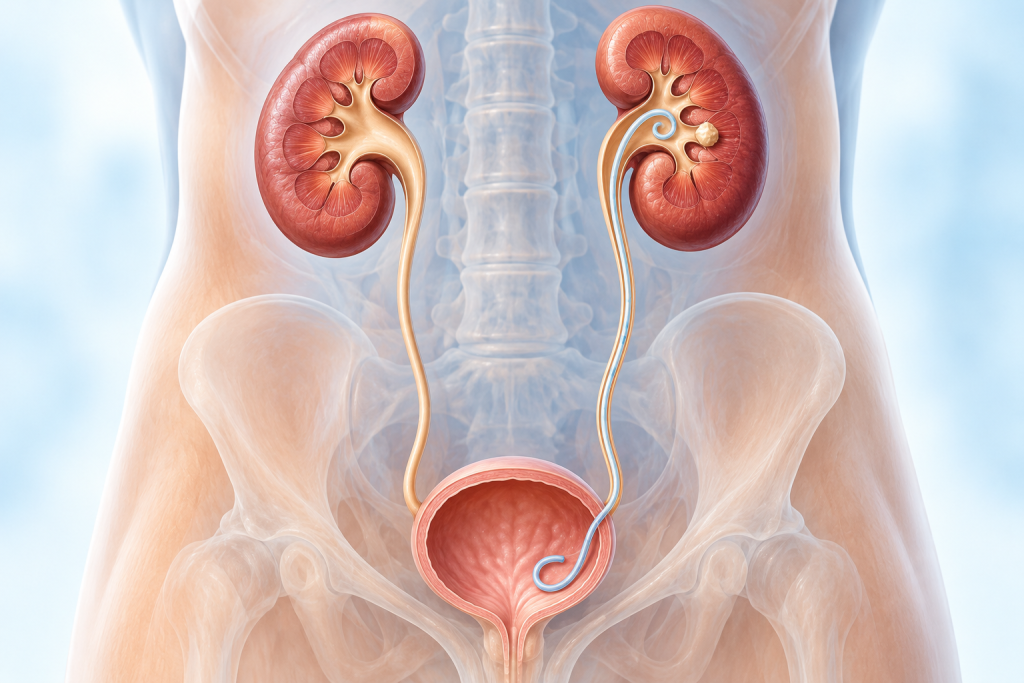
A Stent After Kidney Stone Surgery: Questions to Settle Before Going Home
After kidney stone surgery, learning that a temporary tube has been left inside can raise several questions. Patients may wonder why it is needed, whether the procedure worked and how the tube will eventually be removed.
A ureteral stent is a thin, flexible tube placed in the ureter, the passage connecting the kidney to the bladder. It may be used after certain procedures to help urine drain. Having a stent does not, by itself, mean treatment was unsuccessful.
Ask why the stent was placed
The reason depends on your condition and the findings during surgery. Ask your surgeon to explain its purpose in your case and how it fits into the remaining treatment plan.
When discussing laser treatment for kidney stones, ask beforehand whether a stent might be necessary. This gives you time to understand the possibility and arrange follow-up.
Know which symptoms to discuss
A stent can be associated with urinary frequency, urgency, discomfort and blood in the urine. Symptoms vary between patients and should be discussed with the treating team.
Before leaving after your kidney stone removal procedure, ask which symptoms are expected and how to manage them. Confirm your medicine instructions, activity guidance and any individual fluid advice.
Fever, chills, severe or worsening pain, inability to urinate or heavy bleeding require urgent medical assessment.
Get the removal plan in writing
Confirm whether a stent was inserted, when it should be removed or exchanged, and how that appointment will be arranged. Keep these details with your discharge documents.
Do not assume the stent will pass naturally. If an external string is present, follow the clinic’s instructions and avoid pulling it unless specifically directed.
If an appointment is postponed, contact the clinic to confirm the revised plan.
Use follow-up to plan beyond recovery
Ask whether further imaging, stone analysis or prevention advice is needed. Your kidney stone treatment plan should cover both immediate recovery and subsequent review.
At Credence Urology Clinic in Ghatkopar, Dr. Bhargav Shah can discuss treatment options, explain the possible role of a stent and help you understand the next steps.
Frequently Asked Questions
- Why might I need a ureteral stent after stone surgery?
A stent may be placed to help urine drain from the kidney to the bladder after certain procedures. Your surgeon can explain the reason in your case.
- Does having a stent mean the surgery was unsuccessful?
No. Stent placement alone does not indicate treatment failure. Ask your surgeon about the procedure’s findings and whether further treatment is planned.
- Can a stent cause urinary symptoms?
A stent can cause urgency, frequency, discomfort or blood in the urine. Ask which symptoms are expected and which require medical attention.
- When should the stent be removed?
The timing depends on your treatment plan. Obtain a written removal or exchange date and contact the clinic if the appointment is delayed.
- Can I remove the stent myself?
Only do so if your treating team has specifically instructed you. If an external string is present, avoid pulling it without clear guidance.